Back in the day Norm had a Yashika FX 3 film camera. As a result we did not take anywhere near the number of photos as we do now. What you see below is it. Better than nothing.
And yes we do know the flag is hanging upside down :-).
We had not been on a major trip since our honeymoon in 1980 and felt it was time to return to Europe. Although Gayle had been to Portugal 10 years earlier, in 1974, Norm had not travelled there, yet had a desire to do so.
After considering the economics - Portugal being one of the cheapest European countries in which to travel - we decided to proceed. We planned to go in the Spring, when the flowers would be in full bloom, a great decision as the variety and colour of the wildflowers were one of the most memorable aspects of the trip.
Gayle was very keen to go to at least one of the islands in the Azores or Madeira. We chose Sao Miguel in the Azores but after seeing a Travelogue on Portugal, including both Sao Miguel and Madeira at the Dal Arts Centre the week before our trip we quickly decided to visit both. Also a good decision.
We left April 26 on what turned out to be on the longest travel days we have had. From Halifax we flew overnight to London where we had a five hour wait before boarding our next flight to Madrid. Then after a short one hour stopover we were again in the air on our way to Lisbon. Two and a half hours later we boarded our final flight to Ponta Delgada, Sao Miguel, one of the nine island making up the Azores in the mid-Atlantic..
Of course sleep was extremely difficult to come by resulting in us crashing shortly after finding a hotel.
The next day we would begin to explore the island.
__________________
The Azores are located in the middle of the North Atlantic, due west of Portugal.
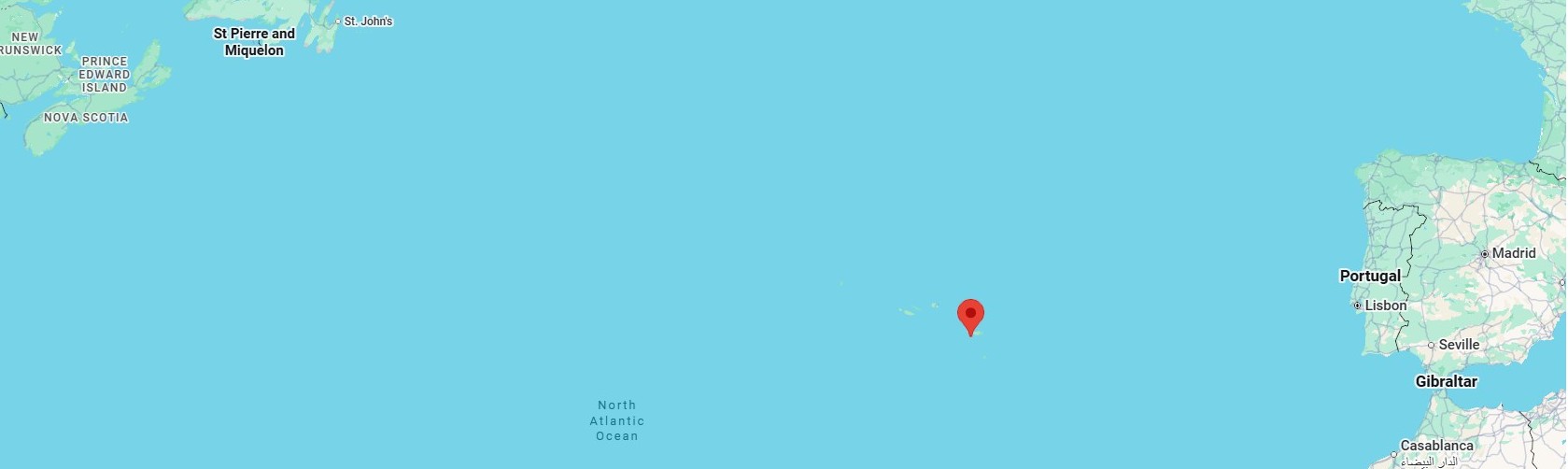
The capital of Sao Miguel is Ponta Delgada, small enough to be easily walked yet large enough to provide all of the facilities of a a regional capital..
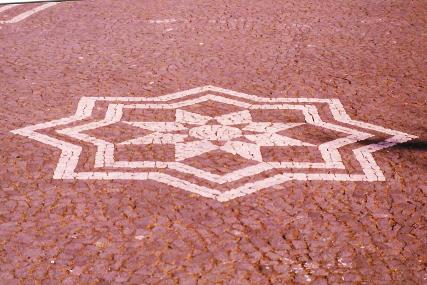
What initially impressed us (although we were to see many other examples throughout Portugal) were the cobbled walks and streets. Intricately designed white and dark stones were used to create endless intriguing patterns and designs in squares and along the waterfront, as seen here.
After having breakfast in a a pleasant alcove of our hotel, overlooking palm and banana trees we wandered about town, doing a bit of shopping. We were startled at how cheap everything was, for example a bottle of wine for $1.50! We It as then we knew we were going to really enjoy ourselves
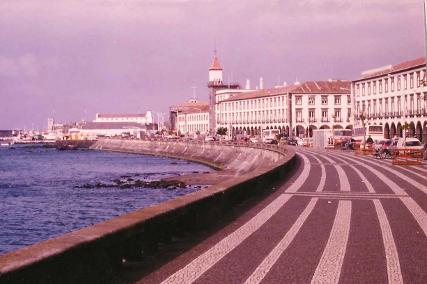
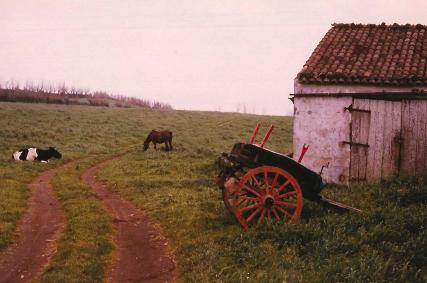
We decided to immediately rent a car to explore the island. Car rental was one aspect of the trip that was not inexpensive, especially in light of what we got, a Morris Mini! Lots of fun on those cobble-stoned roads!
We were in no hurry and thus took many side trips. Here are a few farm animals, an old cart, and an equally old barn. Unfortunately, if became quite foggy as we climbed into the hills in search of Lagoa Fogo, or Fire Lake. The clouds eventually forced us to return to the coast. But the excitement wasn't over as we soon found ourselves in the midst of a car rally - quite an experience on our first day.
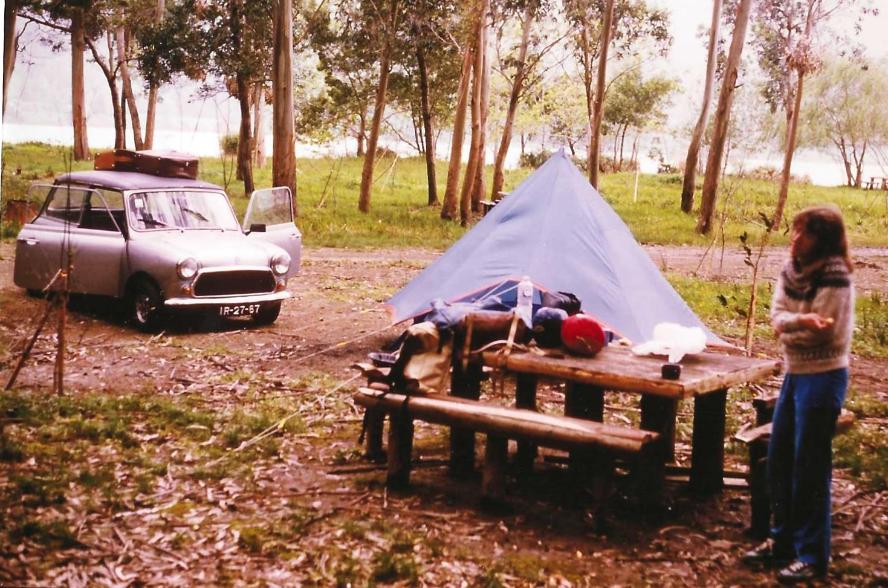
We came to Portugal prepared to camp but expected it to be a bit warmer than this. Fellow campers were few and far between. Never-the-less we enjoyed ourselves. Looking back we were quite fortunate to have had our tent and sleeping bags as accommodation was quite scare in areas we ended up camping. As well, what we saved in lodgings provided us with justification (not that we really needed any) to eat at some nicer places on occasion, as we did this night at Hotel Terra Nostra in nearby Furnas.
The drive to Furnas was extremely scenic, driving through a winding valley fresh with the scent of cedar trees and vivid with the colours of azaleas in full floom
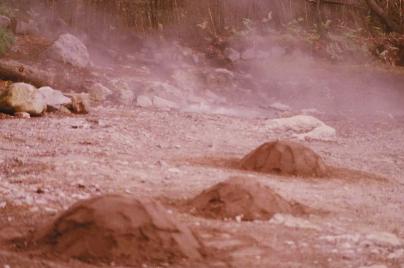
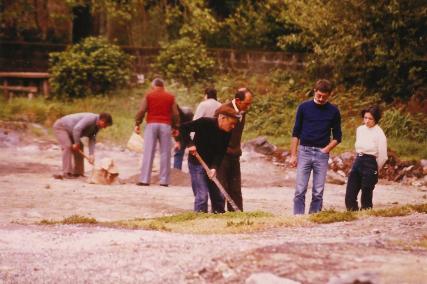
The Travelogue we saw mentioned / showed a custom of inhabitants of this area cooking their food using the heat of the volcanic steam escaping the earth. We were fortunate to be here on a Sunday, the day this is done, as seen here. We watched families burying their meals - dinners, usually a type of stew wrapped in bags, lowered into holes, some of which were pre-lined with concrete, and then covered with dirt. Placing one's hand in one of these uncovered holes one could feel the fairly intense heat. The one thing that we wondered was whether the smell of the sulphur be noticeable in the taste of the food. Unfortunately, we never had the chance to sample a meal cooked in this fashion.
April 30, 1984 - Lagoa Furnas to Sete Cidades, Sao Miguel, Azores
The drive to Furnas was very scenic, driving through a winding valley with the scent of cedar trees and colours of azaleas in full bloom. During the Travelogue we saw it was mentioned and showed a custom of locals cooking their food by burying it in the ground to be 'cooked' by the hot volcanic steam escaping from the earth.
We were fortunate to be here on a Sunday, the day this means of preparing dinner is practiced. The dinners, usually a type of stew, are wrapped in bags, lowered into holes, some of whihc were pre-lined with concrete, then covered with dirt and allowed to cook. The amount of heat was obvious when one placed their hand over an uncovered hole. One thing that left us perplexed was the smell of sulphur. We suspected the food would have a noticeable taste given what we smelled in the area. However we never had the opportinity to sample a meal cooked in this fashion so don't know.
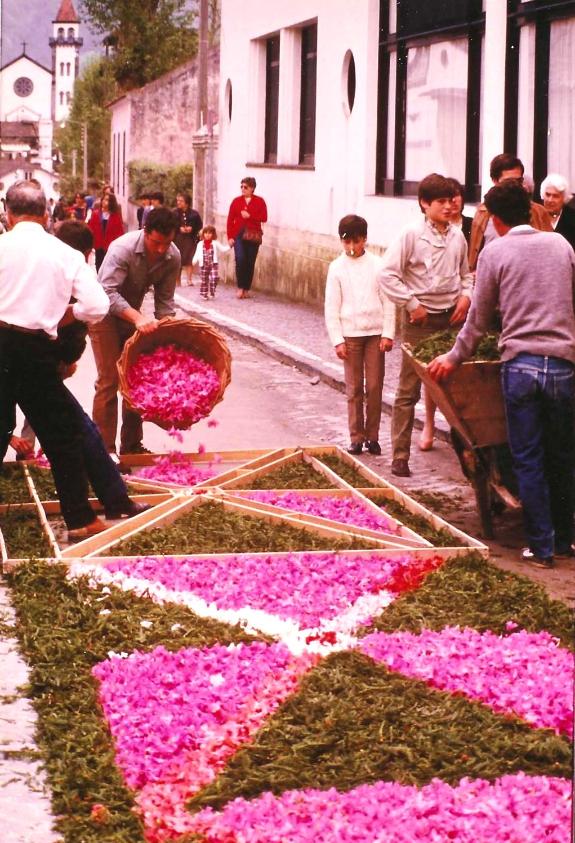
One of the frustrating things we have experienced in our travels is our poor timing when it comes to being in the right place at the right time as far as festivals are concerned. We are inevitably a day late or alternatively too early, without the time to stay. Recall the festival in Foix, France we planned to attend on our honeymoon. The info we had was the festival ran for four days from a Thursday to Sunday. We planned to arrive on Thursday but unfortunately that day all that was going on was setting up the bleachers. No actual festival until the weekend by which time we had moved on.
However this trip was exactly the opposite. Our good timing was beyond belief, and always with no planning. Here in the village of Furnas on one Sunday in the spring the streets are covered with azalea petals, spruce buds and other flowers in attractive patterns and designs. Every street leading to the church was decoarated in this manner as part of a religious procession that passes over and along the streets. An extremely interesting and attractive sight, and as said, good timing on our part.
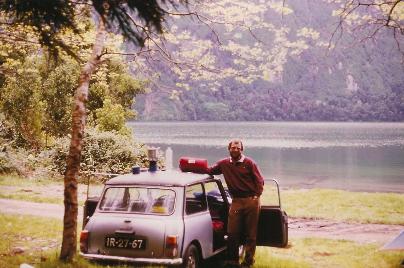
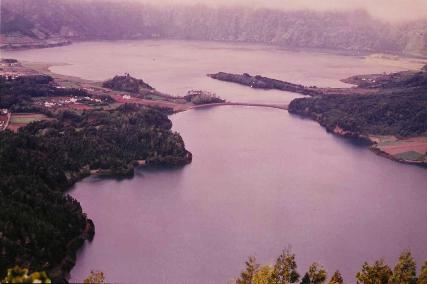
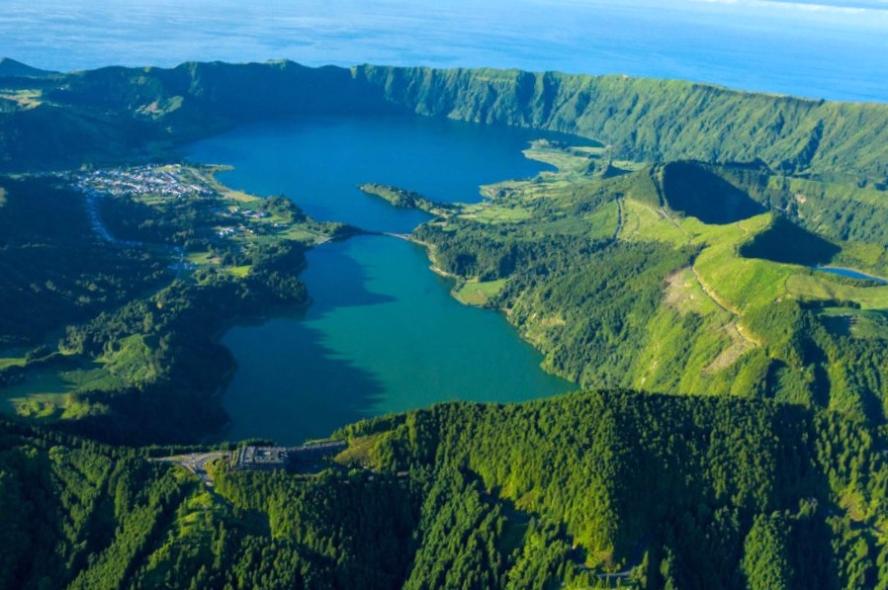
Sete Cidades are seven villages located within a volcanic crater (inactive of course) which is dominated by two lakes. Although this photo does not show the respective green and blue colours due to the cloud cover. The furthest lake is very blue i colour while the nearest is green. The entire crater is quite a spectacular sight, particularly as it hs yet to be developed. As a matter of fact there is only one eating establlishment nearby, To call it a restaurant would be overly generous for it iws nothign more than a room off th eside of a local bar. Despite the absence of a menu (or spoken English) the food was local, excellent and unbelievably cheap.As can be seen we camped on the shores of the Lagoa Verde in what was an excellent spot.
May 01 to May 03, 1984 - Ponta Delgada, Sao Miguel, Azores
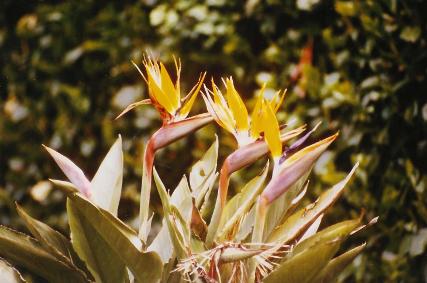
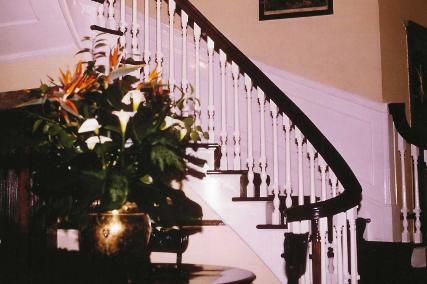
Another very good decision as the room, the sevice, the food, the flower arrangementss and on and on were just perfect. Upon entering our room that overlooked the harbour we were immediately struck by the copper vase containing an arrangement of Birds of Paradise. We spent a relaxing three days here, simply enjoying the comforts of the hotel.
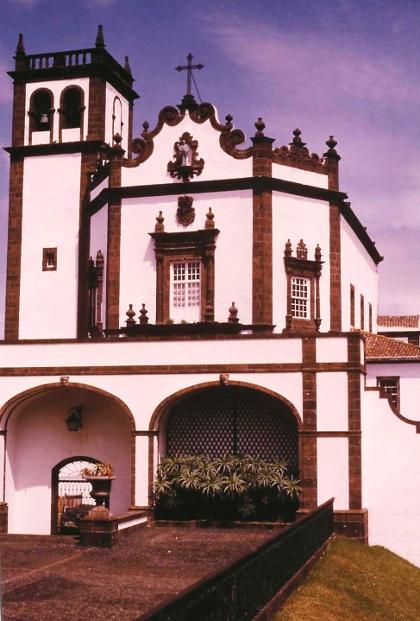
Below left is a a view of the Church de San Pedro, adjacent to the hotel as seen from the window of our room. And right we have a view of the staircase, with the ever present flowers adding brightness and freshness to every room. Without a doubt the best value for the price we have ever experienced in accommodation.
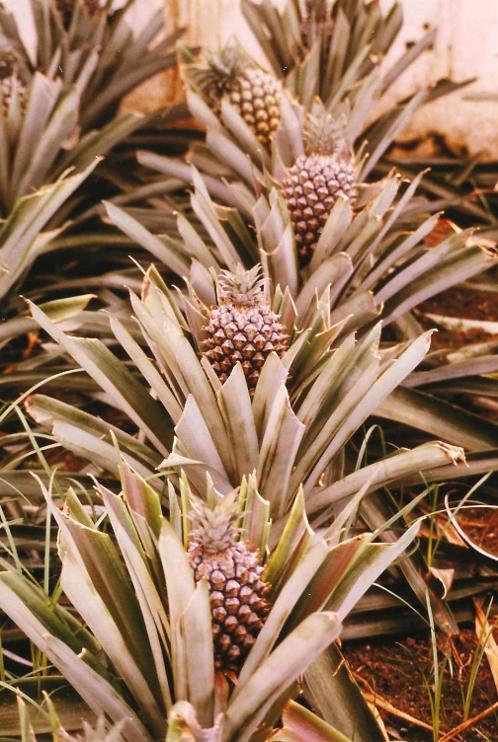
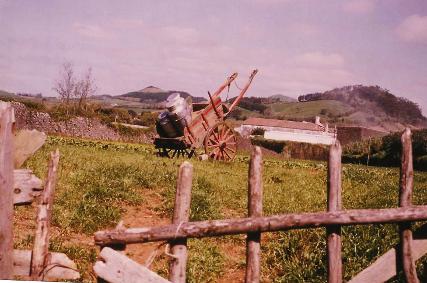
In many ways Sao Miguel is still very backward. There are many examples, especially in the rural areas where modernization has yet to take over. An example is the delivery of milk, still done in large metal cans, drawn in old carts by horses and donkeys.
May 04, 1984 - Sao Miguel, Azores to Madeira (Funchal)
We left Sao Miguel and the Acores on a 1 1/2 hour flight to Madeira. From the airport it is more or less a 45 minute bus trip from the airport to the capital Funchal. The drive was very impressive with rugged coastal terrain and the multitud of colourful flowers along the roadside and in virtually very garden throughout the island.
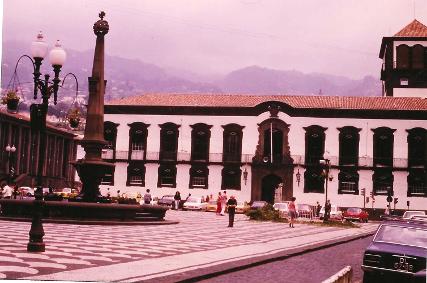
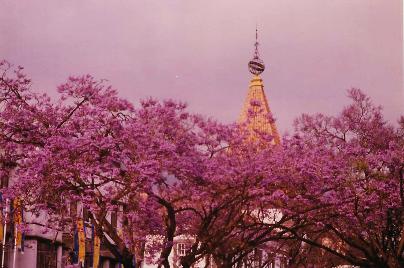
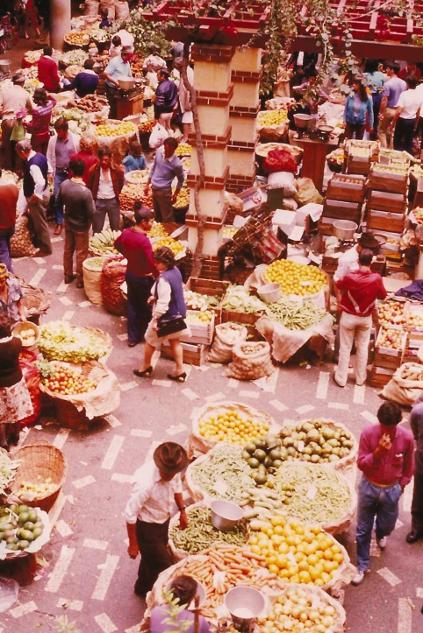
We spent a day in Funchal before renting a car to tour the island. The city was ablaze with colour in preparation of the annual Festival of Flowers to be held the coming weekend. Once again our timing was perfect.
The central part of town was decorated with banners along with trees being in full bloom. We did some window shopping, primarily looking for embroidery for which Madeira is noted but not finding any to our liking.
May 05, 1984 - Madeira (Funchal)
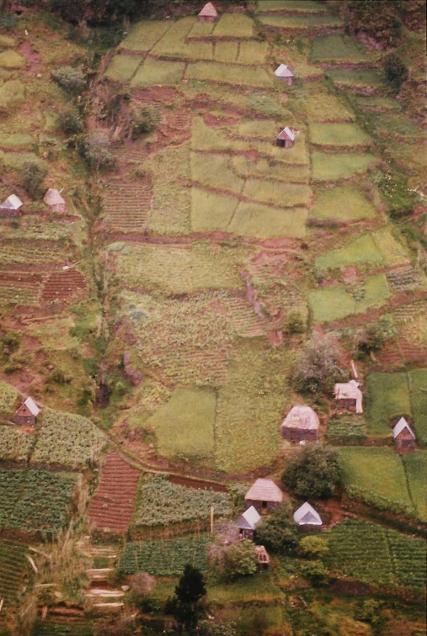
The terrain of Madeira has to be seen to be believed. Being of volcanic origin it is extremely mountainous, separated by long steep valleys. Yet in spite of the steep slopes and inaccessibility virtually all of the land is cultivated. Vineyards, banana groves or market vegetables dominate the agriculture. These fields / plots are as seen across the valley from the road.
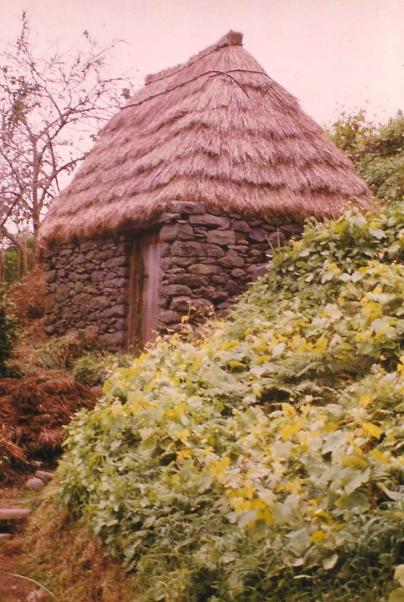
The majority of the buildings in this region were of volcanic rock, covered with thatched roofs. We read that the animals were housed in huts similar to this, they not being allowed to graze due to the steepness of the slopes. Many homes in this area were also unique with their thatched roofs.
May 06, 1984 - Madeira (Funchal)
The bananas are of a smaller variety than those that we are accustomed to in Canada, but were quite plentiful.
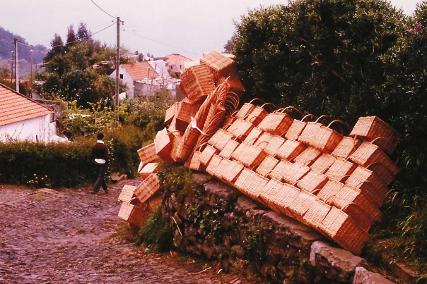
Madeira (and mainland Portugal) are also major producers of wicker-ware. The major factory in Madeira is in Camacha to which we went 'just to look', as we had (or at least we thought we had) no room to carry much. Well don't ask us where we found the room but we brought a wine rack, a picnic basket, two wine servers and a serving tray - and it hurt to stop there for the values were simply excellent. The wine server, for example, for which we paid $1.15 is $9.00 here in Halifax. Need we say more!
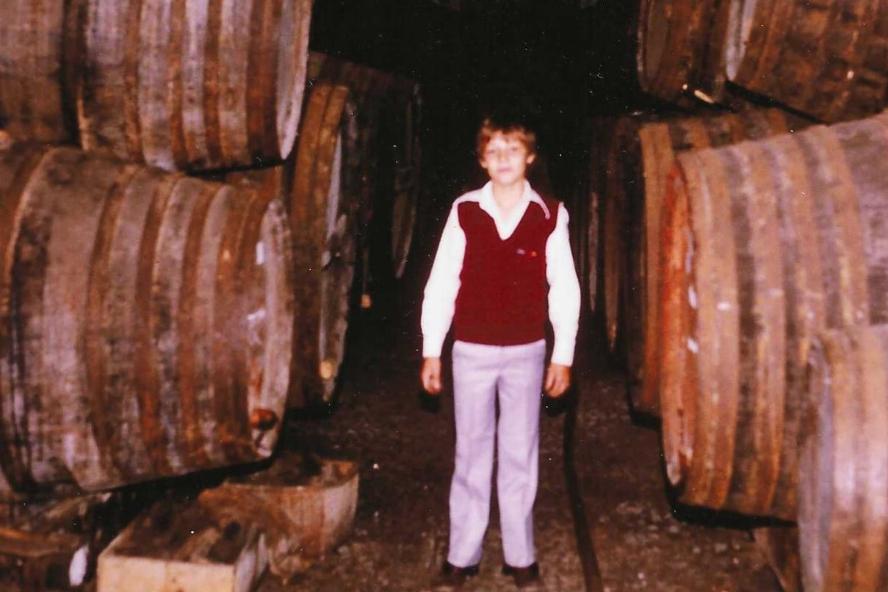
Madeira is also well known for its wine, mostly fortified and known for its incredible longevityand its smokey, nutty, caramel flavours. Wines range from dry to sweet, produced through unique heating and oxidation methods - then stored in estufagems (tanks) or canteiros (barrels) that allow it to last for centuries.
We were amazed with where one would find vines, planted often in locations we would have thought would be virtually inaccessible. The Madeira Wine Company is located in Funchal itself. While visiting this young fellow took us on a complete, and we mean complete, tour of the operation. Unfortunately he could speak no English which resulted in a great deal of pointing and smiling It was an interesting tour none-the-less capped with free samples of each of the four versions made. We ultimately purchased a bottle for $3.60, the equivalent of which is $15 in Halifax.
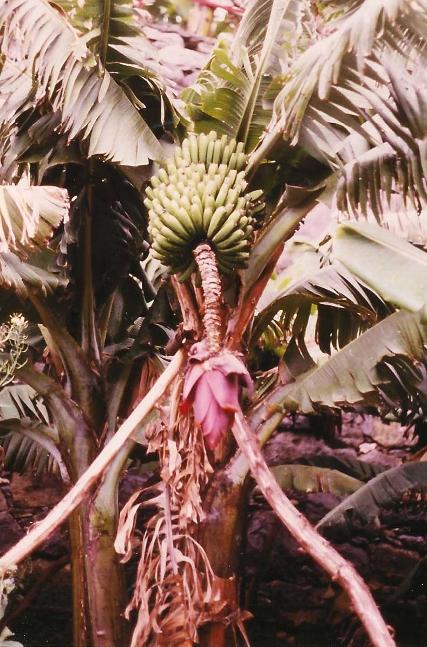
Left: a banana tree with its stem of ripening fruit as well as the flower, quite noticeable due to its size. Note the poles required to support the weight of the branch.
Baskets, piled high on the roadside waiting to be picked up to taken to an outlet.
May 07, 1984 - Funchal to Quiemadas, Madeira
We were told at the Funchal tourist office there was a park up in the mountains, inland from Santana.
We drove up a narrow one lane road, passing women working on their wickerware, in anticipation of finding an appropriate place to camp.
We did indeed discover a park but as far as camping was concerned it did not appear to offer many facilities. There were some nice thatched roof lodges an some well manicured gardens but no campground.
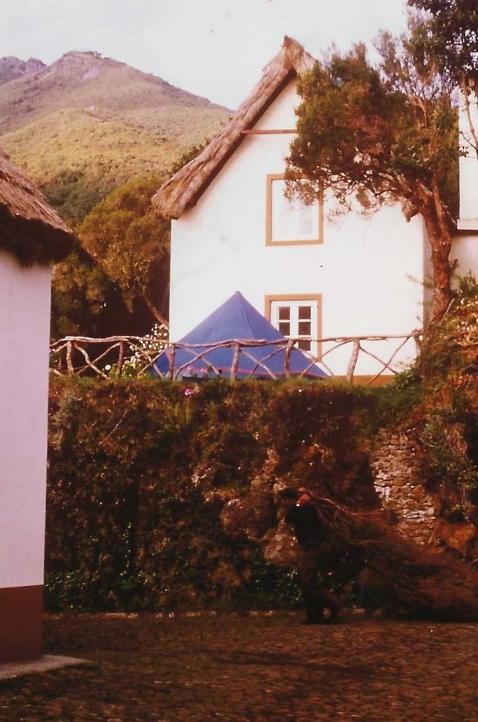
We finally saw a gentleman and attempted to inquire as to where we had gone wrong. Unfortunately he could not speak a word of English which forced us to rely on our phrase book. Although we were still confused he did direct us to set up out tent, as seen here, on the lawn of one of the homes. Now being nighttime we accepted his offer.
After a walk through the gardens the gentleman gestured for us to come into one of the buildings. An impressive lodge it was, as it should be, for we were able to conclude from the care-takers attempted explanation that this was the retreat of the government of Madeira - which explained the gardens and the isolation. We would expect the number of Canadian tourists to have camped at the Madeiran government's retreat would be quite limited - perhaps only us. A very interesting experience!
In reality the Queimadas Forest Park ia walking, hiking, connect with nature, park, but not a campground. It is the location of the Laurisilva of Madiera, a 20-million-year-old subtropical rainforest covering 20% of the island. The area was declared a UNESCO World Heritage site in 1999. As the largest surviving laurel forest, it hosts unique endemic species such as the Madeiran long-toed pigeon, thriveing in high humidity, largely on northern slopes, acting as a 'living fossil' from the Tertiary Period.
As well the Casa de Abrigo das Queimadas (shelter), which maintains the original features of the old Casas de Santana, such as the thatched roof, and access to various hiking trails, such as PR 9 - Levada do Caldeirão Verde or the trail that leads to Pico das Pedras.
May 08, 1984 - Queimadas to Porto Moiz, Madeira
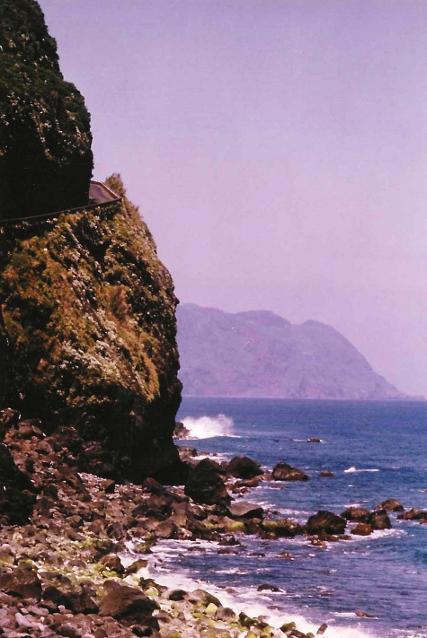
We left Queimadas to the most north-west of the island, Porto Muniz. Until this experience the most scenic area Norm had driven were along the fjords of Norway. But the north coast of Madeira was another level. The coastline is dramatic, and majestic, particularly when seen on a cloudless, warm afternoon. The rich blue Atlantic ocean contrasting the dramatic gorges and valleys, most of them covered with vines of this year's grapes. The drive, at times hugging the cliffs of the sea while at others winding through the inland valleys was simply wonderful - highly recommended!
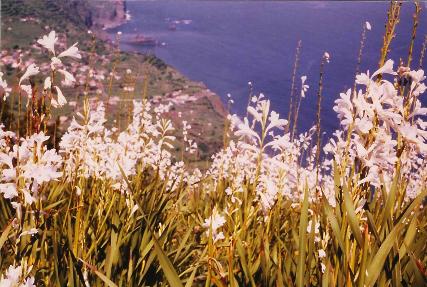
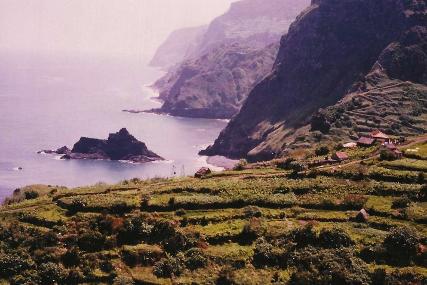
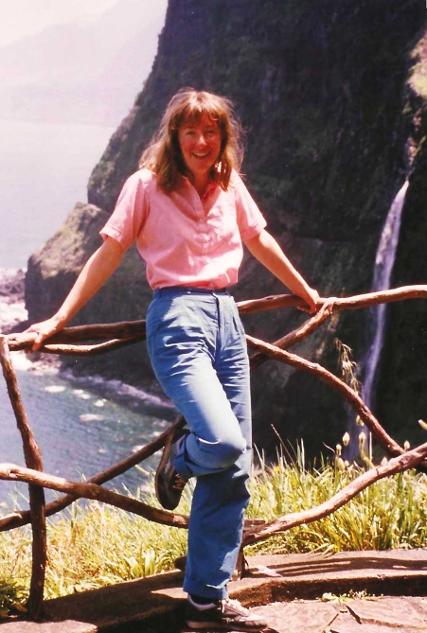
On the left one can see the road ascending and rounding th ecliff. Then on the right, if you look carefully you see the same road just over Gayle's right arm! The drive then continued along the cliff, actually passing under the waterfall before winding to this vantage point.
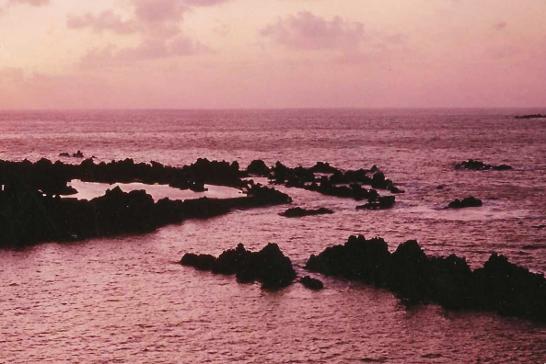
We soon arrived in Porto Moniz, the main village on the north-west corner of Madeira. It was fortuitous that we had our camping gear for there were no accommodations in town! After basking in the sun for awhile we set up on the edge of the ocean with the view as seen here. A spectacular sunset capped a simply wonderful day.
It was fortuitous we had our camping gear for there were no accommodations in town!
After basking in the sun for a while we set up our tent on the edge of the ocean with the view as seen here.
A spectacular sunset capped a simply wonderful day.
May 09, 1984 - Porto Moniz to Funchal, Madeira
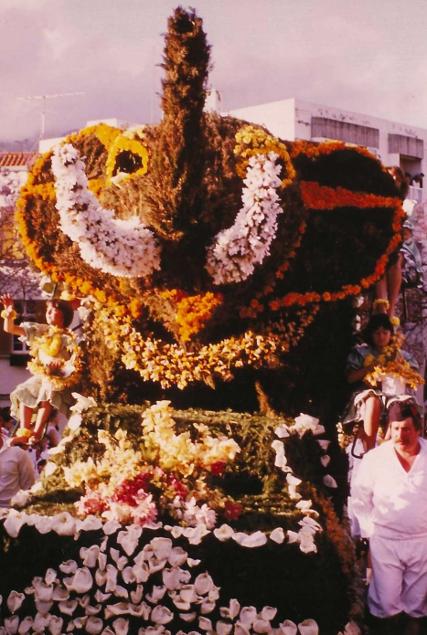
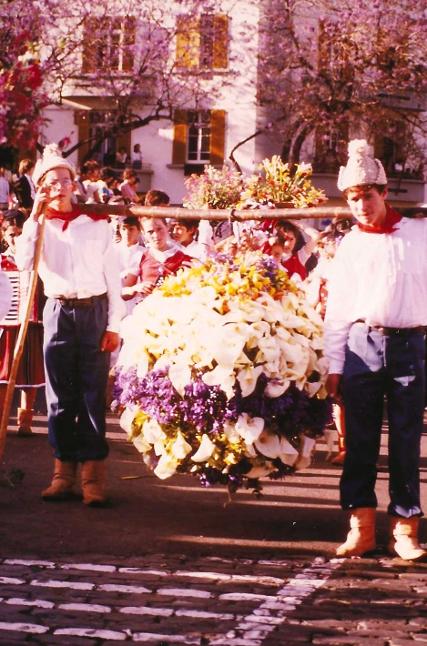
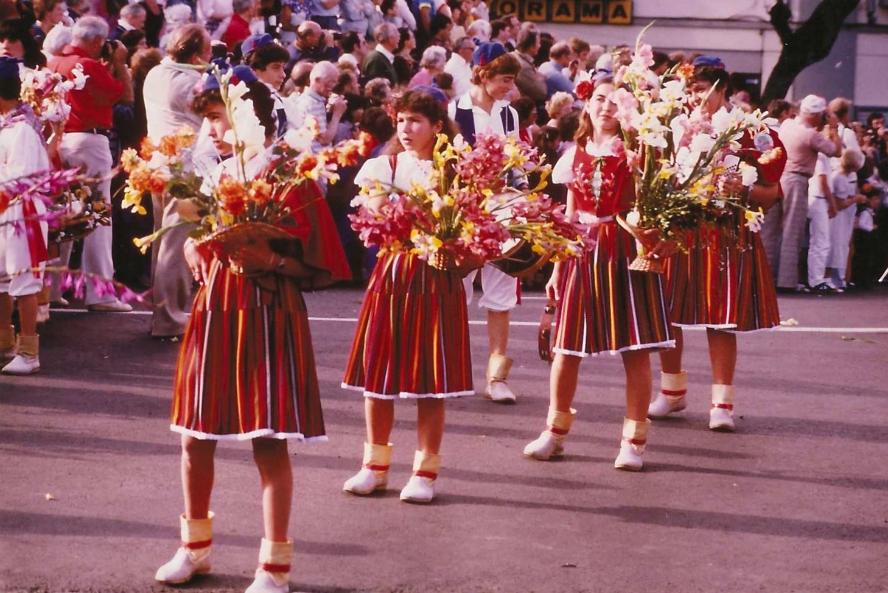
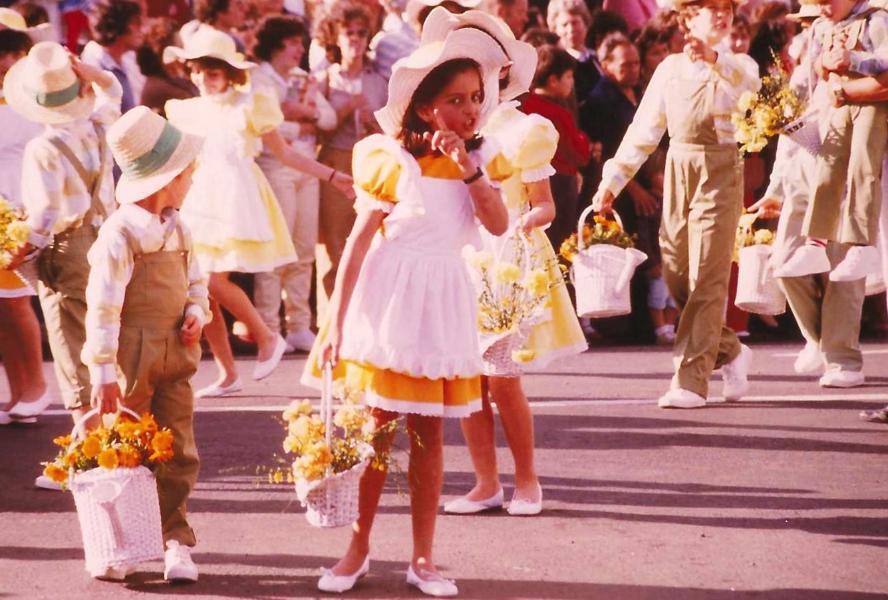
The Madeira Flower Festival Parade is an event worth going out of one's way for. In fact we extended our stay in Madeira one day in order to attend the festival.
The colours and aromas of the flowers, the traditional dress, and the cute young children were something else. The parade took about an hour to pass any given point, finally terminating in the town's square where the flowers were distributed to anyone what wanted them. All the while bands played all types of music, from rock to fado to folk. There was dancing and just generally a festive mood.